

How to Create and Implement a Customer Journey Map from Scratch
Written by @Vasileia Anagnostopoulou

Let’s start from the basics, What is a CJM?
A CJM is a visual story of your customer’s interaction with your brand. It includes all the steps & touch points that your customer goes through when interacting or communicating with you.
It focuses on expected (ideal) and actual experiences received per step. The difference between these two, points out the need for solutions design (coming either through experts’ review or through customer validation).
Why should you run a CJM?
Whether your organisation is in the middle of digital transformation, restructuring, redesigning/optimising processes, or nothing at the moment, a CJM is the stepping stone which will enable your success moving forward and you will have it as a point of reference in anything you dο. Why?
👍 You dig deeper into understanding your current situation — In order to get where you want to be, you need to firstly visualise your current situation, priorities and challenges. The CJM will act as a stepping stone which will help you clearly identify where you are standing now compared to where you want to be.
👍 You identify gaps between the current and the ideal state — After understanding your AS-IS map, you enable yourself to visualise the gaps between the current situation and the ideal one (TO-BE), and focus on the right direction!
👍 You design solutions based on your customer’s perspective and your stakeholder’s needs — The CJM will enable you to step into your customers and stakeholders shoes and see the business from different perspectives. You will gain insights into common customer pain points and have a clear direction on how to improve them. Of course always in alignment with your stakeholder’s needs and priorities.
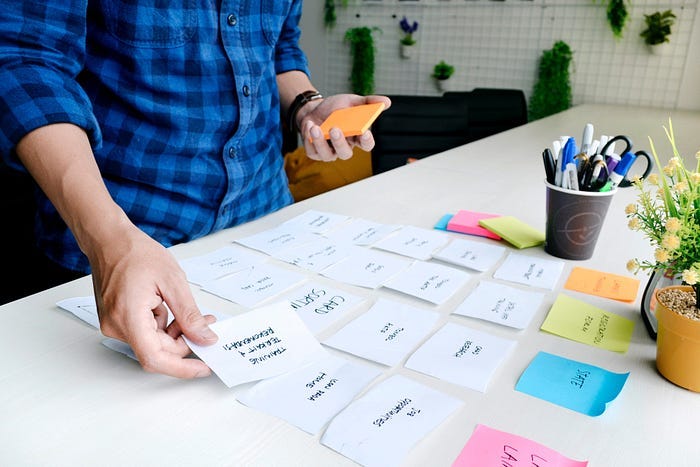
Okay, but How?
Enough with all the theory, let’s step into the practical stuff!
I will share with you a practical guide, created after running many CJMs for our clients, gathering up all of our learnings and tips on how to implement a CJM from scratch!
Your process should follow a holistic approach, by taking into account all the different aspects and perspectives, internal and external, based on actionable data, interviews and business analysis.
So, let’s start!
Make sure everything is Data-backed
Start your research by collecting all the necessary existing info & data: Anything that can help you understand your business and organisation more in depth is valuable at this point, you can collect org charts, satisfaction surveys, NPS, communication flows, competition analysis, sales data, internal processes/guidelines etc. As well as access to internal tools to navigate by yourself.
All of this information should be gathered upfront as it will support your analysis and outcomes with actionable and real data moving forward.
2. Understand your Stakeholders challenges and priorities
Move on with your stakeholder’s perspective: conduct internal interviews with key stakeholders to understand their point of view, the main challenges that they are facing and the priorities that they want to set, get their direction in order to build their TO-BE map.
💡 Tip: Build a script and share it with the stakeholders in advance, so that they can prepare themselves for the interview and you can make sure to ask the right questions.
3. Step into your Customers shoes!
At this point, you will dig into the customer perspective. You can build and run customer satisfaction surveys targeted to different customer segments based on their buying behaviours (if you have done that recently good for you, just collect the data and analyse them).
The above will give you many insights on your business, examine different segments of customers in order to understand their experience and gather their feedback on the journey (example of segments: champions, loyal, high potential, at risk, etc.).
Consider also hosting quick chats with customers that are interested (via telephone or zoom), in order to deep dive into their experience!
And of course, you should become the real customer by shadowing the process and journey by yourself.
4. Build your Personas
In combination with the data that you gathered in step 1, you should take advantage of your Google Analytics account. Focus on analysing buying behaviours, acquisition channels, technology & devices, source/medium, user flows, demographics and interests.
This way, you will conclude your main persona flows, in order to support your strategy moving forward, understand how to target different audiences, build content based on their interests and focus your whole communication on addressing their needs.
5. Create your Template and Structure
The visualisation and content of your CJM, is getting built throughout this process. It’s an ongoing work, and it gets updated all the time based on the insights that you gather at each stage.
Once you complete all of the above phases, it means that you’ve gathered & analysed all the necessary information that you need in order to finalise your CJM and visualise the key outcomes & touch points in your map (you can use miro as a visualisation tool).
The most important thing for a successful CJM is the clear distinction & definition of the different stages that the customer passes through.
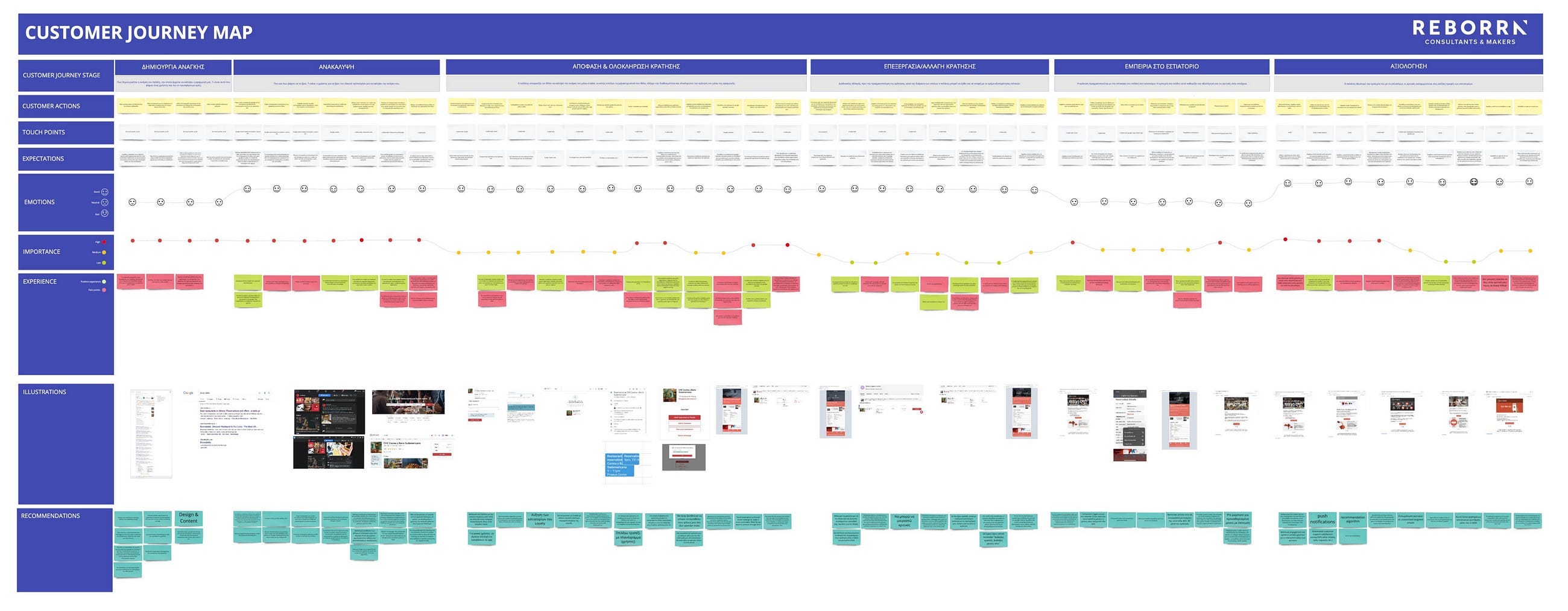
👉 Therefore, Horizontally, you will present the different phases of the customer journey experience. Where does it start, how do you approach the customer, how does he/she learn about you and how do you retain them, follow up, upsell etc.
👇 Whereas Vertically, you will map the current journey (customer actions), touch points, ideal journey (expected actions), emotions, importance, opportunities & challenges, illustrations and recommendations presented and analysed per horizontal stage.
💡 Tip: It’s helpful to write down brief descriptions of each stage from the beginning, as it will help you validate your customer actions moving forward whenever you feel like it’s needed!
What should your CJM look like?
One size does not fit all however, based upon the above guidelines & structure, following you may find an indicative template of what a CJM could look like.
The granularity that you will get into and the level of detail that you will present on your map depends upon your business, your stakeholders needs and your expected outcomes. There is no rule for that, every CJM should get adjusted to each use case accordingly.
Just have in mind to present the most valuable outcomes so that they are clear, to the point and easy to be read by your stakeholders.
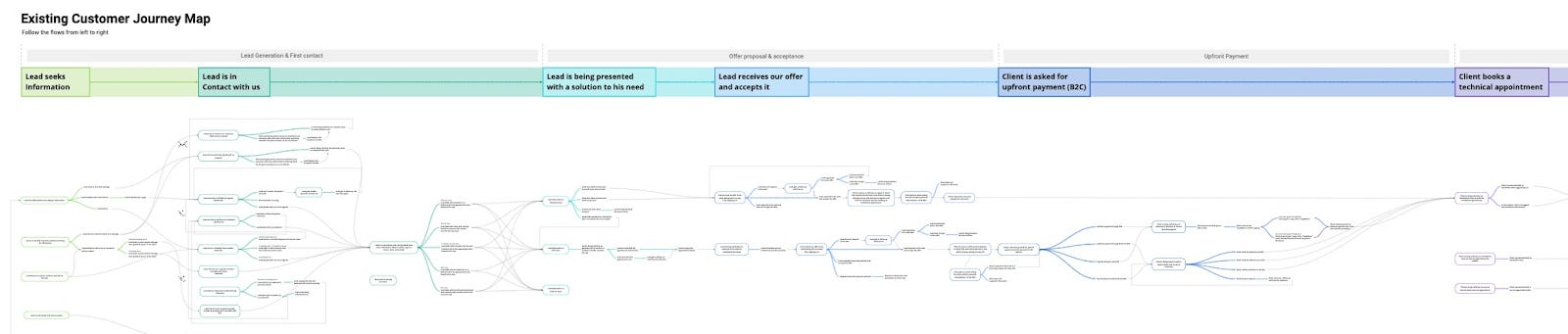
Avoid creating a huge and messy CJM, where you add all the information that you gathered, without distinguishing the valuable outcomes from the nice-to-have ones.
Here is an example of a not so easy to read CJM, where the distinction between the stages and the visualisation of the different customer actions, touch points and challenges is difficult to be presented in one map.
💡 Remember: a CJM’s purpose is to bring value to a company, address the stakeholders requests and find solutions to their challenges and needs.
That’s it!
At this point you may be wondering: “How much time will the process take to be completed?” The answer is around 3–4 weeks and it is definitely worth it.
An efficient CJM can help your organisation succeed by making sure that you are headed towards the right direction, always in alignment with your key stakeholders and customers.